CONSTRUCTION MANAGEMENT
Construction management include a project manager, planning, estimation, scheduling, tendering, contracts, equipments etc.
What are Causes of Schedule Delays in Construction Projects?
There are various factors that lead to schedule delay in construction project. Factors might be different from one project to another one. In this article, the most important and common causes of delays in schedule construction will be discussed.
Causes of Schedule Delays in Construction Projects
- Construction site access
- Differing site conditions
- Force majeure
- Adverse weather

1. Construction Site Access
Site access is one of the factors that may lead to delays in the project construction schedule. Examples of factors cause construction schedule delay involve the following:
- Inability of the owner, when he/she controls the construction site, to provide information needed for the constructor to achieve permit.
- Failure of the previous contractor to finish its work in the area that is used by successive constructor is another factor of lead to delay construction schedule.
- Security problems which might create dangerous conditions for the contractor, prevent the contractor to access the construction site, or deny the contractor to access the area that on the critical path of construction schedule.
- Environmental problems that have not been dealt with and not been resolved.
It can be noted that, the above factors may occur at the beginning of the construction or before the contractor begin its work and hence it can be stated that construction access lead to early project delays.
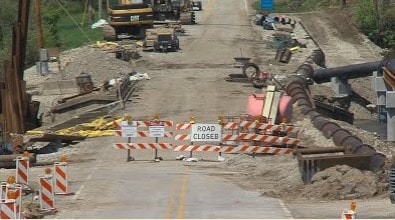
2. Differing Site Conditions
Delays in project construction occurs when site conditions is different from those that expected from contract documents.
Generally, there are two types of differing site conditions. Firstly, delays due to differing site conditions from those provided in contract document i.e. plans and specification.
Secondly, delays happen due to difference between current site conditions and site conditions which are usually encountered at the location of the project.
By and large, delays in project construction occur provided that the following criteria are realized:
- Site conditions are defined or described in contract documents.
- The actual site conditions cannot be anticipated at the time of contract bid.
- The actual site condition is different from those explained in the contract documents.
3. Force Majeure
Force majeure events are not only predictable and avoidable but also uncontrollable. These events are external that influence the performance of contractor and cause the delay of construction schedule.
There are several natural such as hurricane and earthquake, and manmade events like war which constitute force majeure events. These events may be accepted by contract clauses.
Under normal circumstances, delay caused by force majeure is considered as non-compensable. In this case, the contractor can regain the lost time but not the cost of extended overhead.
However, if the owner is the cause of the delay, then it is assumed to be compensable.
4. Adverse Weather
Normally, the majorities of project construction phases are sensitive to weather and hence considerably influence by it.
Moreover, the level of weather sensitivity of various construction stages and types of construction activity is considerably different. Added to that, the influence of weather events varies crucially between construction activities and construction locations.
It is highly likely to extend construction time if long duration of detrimental weather condition is experienced.
The contractor should properly demonstrate that the time of detrimental weather exceeded the expectation of the contractor and affected the development of critical path activity and eventually lead to the delay in the construction schedule.
Construction contract may tackle delays due to adverse weather by providing procedure to regain time lost. A delay caused by extended period of adverse weather is considered as excusable but non-compensable since neither the constructor nor the owner controls the event.
Nonetheless, one should be aware that delay could be compensable provided that weather influenced the contractor because of the owner caused delay. This issue may get worse when owner caused delay push weather sensitive activities into the colder and rainier season.
For example, owner caused delay may force temperature sensitive concreting into the winter and eventually increase the concreting cost. In this case weather related problems may become inefficiency issue.
Site Factors Affecting Construction Cost of Heavy Civil Projects
There are several site factors that lead to increase construction of heavy civil projects. These factors are not the same from one project to another one.
Site Factors Affecting Construction Cost of Heavy Civil Projects
Site factors that increase the cost of heavy civil constructions include:
- Bad weather condition
- Difficulty in accessing the construction site
- Remote construction site
- Short contract period
- Off-site disposal requirements
- Traffic problems
- Quarry or borrow pit permit requirements
- Excavation adjacent to high level of groundwater
- Limitation on how the construction site can be developed
- Limits on working hours
- Restriction on the level of noise in residential neighborhood
1. Bad Weather Condition
One of the major site factors that may increase cost of construction is the bad weather for example continues precipitation and short construction season.

Fig.1: Bad weather condition during construction generates difficulty and damage part of construction project or and equipment and hence increase construction cost
2. Difficulty in Accessing the Construction Site
Difficult accessibility is another factor that increase construction cost. Construction of temporary roads which are used to transport materials, equipment, and personnel to the construction site is an example of raising cost due to difficult access to the project site.

Fig.2: Temporary construction access road
3. Remote Construction Site
If the construction is remote, then it is likely that labor shortage will be encountered. So, labors are required to commute from other places which clearly increase the construction cost. Added to that, transportation cost of equipment and materials will also increase construction cost.

Fig.3: Remote project site increases construction cost due bringing labors from other regions and delivering of materials and equipment
4. Short Contract Period
If the contract period is short, then construction cost may increase due to higher labor and equipment cost. This is because labors required working for longer time and equipment used for longer period to maintain working in night shifts.
5. Off-Site Disposal Requirements
This will lead to increase transportation and disposal costs in landfills.
6. Traffic Problems
Traffic problems and extensive traffic control in an urban setting is another site factor that lead to increase the cost of project construction.
7. Quarry or Borrow Pit Permit Requirements
The achievement of borrow pit requirements need considerable time and it is costly. Borrowing material for construction would influence the environment, so it would not be an easy task to comply with several environmental laws.
8. Excavation Adjacent to High Level of Groundwater
Excavations close to high level ground water for instance excavation adjacent to river, stream, or lake. This will increase the difficulty of excavation operation and hence construction cost would increase.
9. Limitation on How the Construction Site can be Developed
Restrictions on how the construction site can be developed will not only influence the selection of the equipment used for construction but also lead to reduce production rate. As a result, the construction cost will be increased.
10. Limits on Working Hours
Restrictions on working hours will lead to increase number of working days. Limitations on working hours may apply in residential area. So, the cost of construction due to limitations on working hours will increase provided that the contractor cannot be take advantage of daylight for the construction.
11. Restriction on Level of Noise in Residential Neighborhood
Limitation on the level of noise generated by used construction equipment: noise level restriction will influence the selection of equipment types.
Subsequently, certain devices may be selected that their operation would be more expensive for example diesel pumps may be prevented to be used for dewatering excavation in residential area and more expensive pumps need to be used.
Source :-theconstructor.org


